

During my preceptorship at the University of Western States, I learned quickly about the prescribing cascade. I was shocked to see a patient taking 12 prescriptions. My preceptor just laughed. “Oh honey, you ain’t seen nothing yet. That’s not high at all for the elderly.”
She was right. I would not fully understand the reality of this polypharmacy until years later, when I sat at my father’s hospital bedside and asked for his complete medication list. It took three requests before I finally received it: 24 medications. Twenty were prescription drugs.
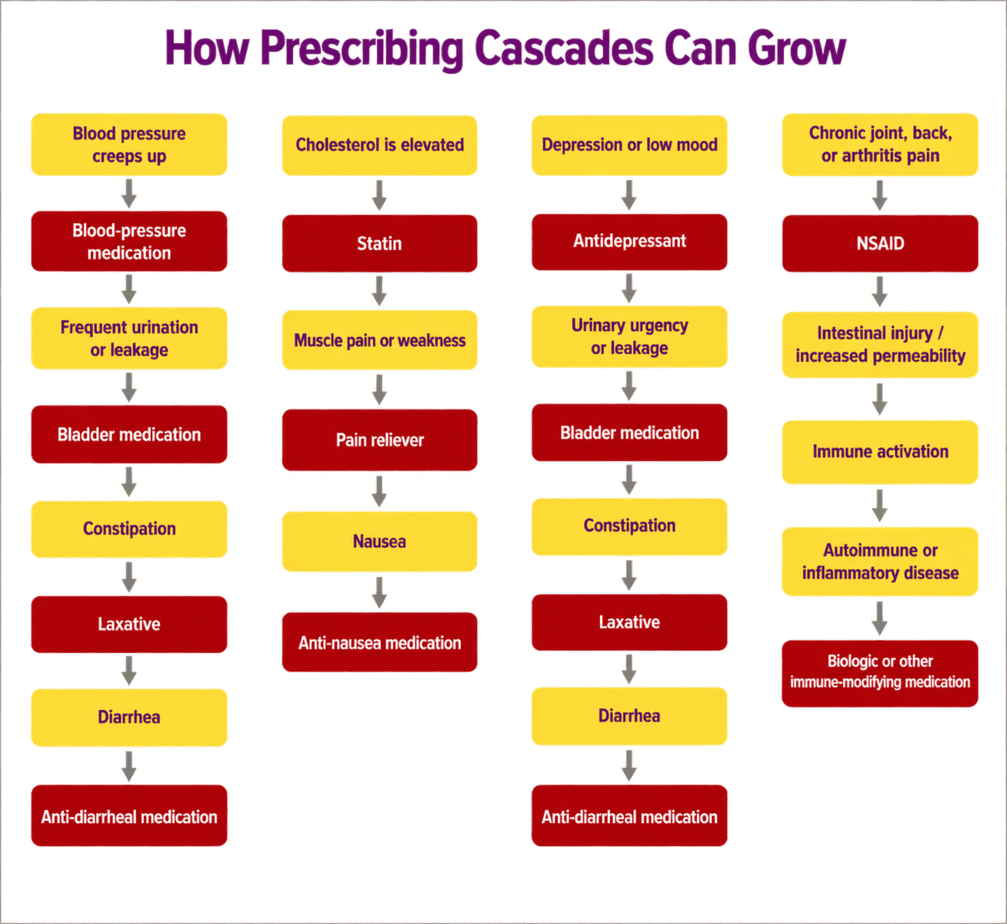
That is how a prescribing cascade can begin. A side effect from one drug is mistaken for a new health problem. Another drug is prescribed to treat it. Then that drug causes its own side effects, and the cycle continues.
A former pharmacist once told me she could often predict which medication a patient would pick up next based on the one she had just filled.
The concept first appeared in The Lancet in 1995 and was further developed by Dr. Paula Rochon and Dr. Jerry Gurwitz in a landmark 1997 British Medical Journal (BMJ) paper. Nearly three decades later, a new BMJ study shows how common potentially inappropriate prescribing cascades may be among older adults.
Researchers analyzed prescription records from more than 2.3 million Ontario adults aged 66 and older. They examined 65 potential cascades previously identified by international experts, then prioritized 24 that deserve particular attention from clinicians and pharmacists.
When a new symptom appears after a medication is started or the dose is increased, the first question should be: Could this be a drug effect?
Too often, the question becomes: Which drug should we add to treat it?
The Top 24 Potentially Inappropriate Prescribing Cascades
The Ontario researchers prioritized 24 medication chains for closer scrutiny. The list doesn’t prove the second medication was unnecessary or that the effect was caused by the first. It suggests that doctors, pharmacists, patients, and families ask whether the first drug may be contributing.
Below are the 24 prioritized cascades, showing the first medication → possible effect → added medication:
- Antihypertensive medication → nausea → antiemetic medication
- Statin → muscle pain or weakness → pain reliever
- Statin → sleep disturbance → sleep medication
- ACE inhibitor → persistent dry cough → cough remedy
- Beta blocker → depression or depressive symptoms → antidepressant
- Calcium-channel blocker → peripheral edema (leg, ankle, or foot swelling) → diuretic
- Calcium-channel blocker → constipation → laxative
- SSRI or SNRI antidepressant → urinary urgency, frequency, or incontinence → overactive-bladder medication
- Gabapentin or pregabalin → peripheral edema (leg, ankle, or foot swelling) → diuretic
- Anticonvulsant → nausea → antiemetic medication
- DPP-4 inhibitor → joint pain → nonsteroidal anti-inflammatory drug (NSAID)
- SGLT2 inhibitor → genital yeast infection or other fungal infection → antifungal medication
- Metformin → diarrhea → antidiarrheal medication
- Proton-pump inhibitor → vitamin deficiency → vitamin supplement
- Proton-pump inhibitor → mineral deficiency → vitamin or mineral supplement
- Laxative → diarrhea → antidiarrheal medication
- Opioid → depression or depressive symptoms → antidepressant
- NSAID → gastrointestinal injury or ulcer risk → acid-reducing medication
- NSAID → nausea → antiemetic medication
- NSAID → increased blood pressure → antihypertensive medication
- NSAID → fluid retention or worsening heart failure → diuretic or other heart-failure medication
- Corticosteroid → insomnia → sleep medication
- Corticosteroid → mania, psychosis, or other severe behavioral symptoms → antipsychotic medication
- Iron supplement → constipation → laxative
Side Benefit vs. Side Effect

Consider #24: Iron supplements—including iron in a multivitamin—commonly cause constipation. The former director of my mother’s assisted-living center told me they used to give residents prunes every day. Now, she said, doctors prescribe laxatives instead. That’s unfortunate because a study found that eating four to six prunes daily helped prevent bone loss in postmenopausal women—so you get a side benefit instead of a side effect.
While prunes won’t replace a laxative when someone truly needs one, they illustrate the broader question behind a prescribing cascade: have we considered a food-based, behavioral, or dose-related solution to the original problem?
Why Older Adults Are Especially Vulnerable to the Prescribing Cascade
Besides having more years for their medication lists to creep up on them, older adults often have multiple prescribers and hospitalizations, growing the list faster than anyone reviews them. My dad had a primary care doctor, a doctor through the Veterans Administration, a cardiologist, and hospital physicians who all contributed to his growing list—with no one examining the full list for potential side effects.
A list of 24 drugs isn’t simply an excessive number. It makes drug interactions, cumulative side effects, and mistaken attribution more likely.
The study’s authors say their prioritized list can guide prescribing and deprescribing efforts to improve drug safety. Yet deprescribing takes time, coordination, follow-up, and a willingness to change or stop medication another clinician started. It’s also unfortunate that doctors may face greater legal risk when they stop a medication than when they write another prescription, giving them little incentive to deprescribe.
Medication lists rarely become overwhelming all at once. They grow one prescription at a time, often across different doctors, offices, and hospital visits, with no one responsible for stepping back to examine the whole picture. Before adding the next medication, someone needs to ask if this is a prescribing cascade.
I’ve written more about why older adults are vulnerable overall in this post:
Read more: Why the Elderly Are Vulnerable—It’s Not Age

Want weekly Scripture, wellness tips, and anti-inflammatory recipes?
Subscribe to the newsletter below.
No spam. Unsubscribe anytime.
Sources
Rochon PA, Gurwitz JH. Drug therapy. Lancet. 1995 Jul 1;346(8966):32-6. doi: 10.1016/s0140-6736(95)92656-9. PMID: 7603146. https://www.thelancet.com/journals/lancet/article/PIIS0140-6736(95)92656-9/fulltext
Rochon PA, Gurwitz JH. Optimising drug treatment for elderly people: the prescribing cascade. BMJ. 1997 Oct 25;315(7115):1096-9. doi: 10.1136/bmj.315.7115.1096. PMID: 9366745; PMCID: PMC2127690.https://pmc.ncbi.nlm.nih.gov/articles/PMC2127690/
Rochon PA, Austin PC, Gurwitz JH, Wu W, Matai L, Zhang T, Li Z, Savage RD, Gruneir A, Li J, O’Mahony D, Petrovic M, Cherubini A, Onder G, Sternberg SA, McCarthy LM, Dalton K, Reppas-Rindlisbacher CE, Stall NM, Normand ST, Giannakeas V. Exploring high priority potentially inappropriate prescribing cascades in older adults: population level retrospective cohort study. BMJ. 2026 Sep 10;394:e100499. doi: 10.1136/bmj-2026-100499. PMID: 42727946.https://www.bmj.com/content/394/bmj-2026-100499
De Souza MJ, Strock NCA, Williams NI, Lee H, Koltun KJ, Rogers C, Ferruzzi MG, Nakatsu CH, Weaver C. Prunes preserve hip bone mineral density in a 12-month randomized controlled trial in postmenopausal women: the Prune Study. Am J Clin Nutr. 2022 Oct 6;116(4):897-910. doi: 10.1093/ajcn/nqac189. PMID: 35798020.https://www.sciencedirect.com/science/article/pii/S0002916523036092