

The health benefits of music were on my mind as I shopped for my mother’s birthday gift. Hoping familiar songs might brighten her days in memory care, I bought her a CD player and a collection of oldies, since she can no longer use streaming devices.
When my uncle was in memory care, my cousin Cheryl noticed something remarkable: when music played, residents’ faces brightened, feet tapped, and some began singing along. When the music stopped, the blank stares returned. Even after my uncle could no longer remember Cheryl’s name, he could still remember words to his favorite songs.
Cheryl’s observations are backed by science. Research shows that musical memory often remains intact until the very late stages of dementia, even after cognitive function has declined. Additionally, music memory regions in the brain are relatively spared in Alzheimer’s disease.
The more I explored the research, the more I realized the health benefits of music go far beyond memory care. Music influences stress, mood, pain, relationships, and even the way we worship.
God’s Gift of Music
God gave us music to reach parts of us that words sometimes cannot.
-
- David’s harp brought Saul temporary relief from his torment (1 Samuel 16:14–23).
- Moses and Miriam led Israel in song after crossing the Red Sea (Exodus 15:1-21).
- The Psalms show that music gives voice to joy, grief, repentance, gratitude, fear, and praise.
- Paul and Silas sang hymns in prison (Acts 16:25), and Paul later encouraged believers to teach and encourage one another through psalms, hymns, and spiritual songs (Colossians 3:16; Ephesians 5:19).
- James adds, “Is anyone happy? Let them sing songs of praise.” (James 5:13)
Music was never an afterthought in Scripture. It was woven into the life of God’s people — and modern research is only beginning to catch up with what the Bible has shown for thousands of years.
What the Research Says About the Health Benefits of Music

An observational study of older adults found that those who listened to religious music more frequently reported lower death anxiety and greater life satisfaction, self-esteem, and sense of control.
However, research extends well beyond religious music. Evidence shows that music therapy can positively influence many aspects of physical and mental health.
Research suggests benefits in several key areas:
Pain Relief
Multiple studies show that music therapy can significantly reduce chronic pain and associated depression. Effectiveness varies by condition, but the results are promising.
Anxiety and Stress
Various studies show that music can help lower anxiety and stress.
-
- A 2007 study found that music reduced anxiety in patients before surgery.
- A 2013 study showed that listening to relaxing music before a laboratory-induced stress test helped participants recover more quickly from the body’s stress response.
- Large reviews published in 2020 and 2025 confirmed that music interventions reduced both physiological and psychological measures of stress. The 2025 review also found that sound interventions can positively affect anxiety, heart rate, blood pressure, heart-rate variability, and cortisol, although results varied by intervention and study design.
- A 2026 trial found that sessions lasting 24 or 36 minutes reduced anxiety symptoms more effectively than a shorter session.
Dementia and Alzheimer’s Disease
Though some studies show mixed results, a growing body of research supports music’s role in dementia and Alzheimer’s care.
-
- A 2020 meta-analysis of studies found that music interventions improved cognitive function in people with dementia, along with quality of life and reduced depression.
- A 2023 review focused specifically on Alzheimer’s disease found a similar improvement in cognitive function across the studies reviewed, most of which were rated high quality.
- A 2025 meta-analysis of 24 randomized controlled trials found that patients receiving music therapy showed higher cognitive function and lower levels of depression and anxiety compared to those who did not.
The research tells a consistent story: music doesn’t just entertain us. It reaches the body and mind in ways few other interventions can. The question is whether we’ll treat it as background noise or as one more gift God has given us to steward wisely.
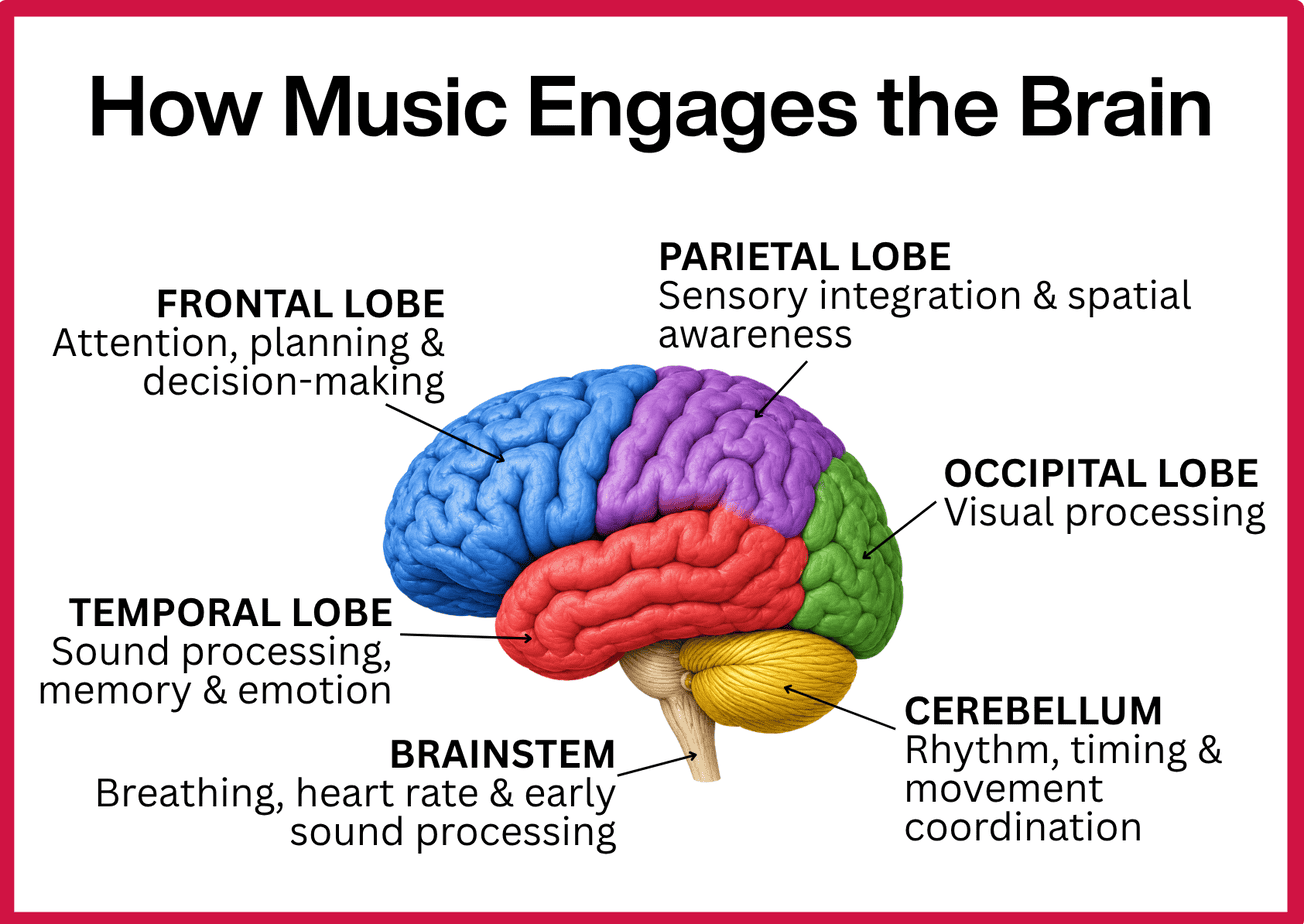
Music for Our Bodies, Brains, and Spirits
Music isn’t a replacement for good nutrition, medical care, or stewardship of our bodies. But Scripture and science point in the same direction. Music has the ability to calm, encourage, connect, teach, and restore in powerful ways because God’s design still works.
While the researchers used different types of music therapy varied in length and type of music, we should never underestimate what a few minutes of music can do. Whether it’s an old hymn, a foot-tapping oldie, or a worship song, it might be just what your body, brain, and spirit needs.
And although my mother no longer remembers our conversations, I pray she’ll remember the music for a while longer and that it might bring her comfort, help her reconnect with old memories, or simply brighten an afternoon.

Want weekly Scripture, wellness tips, and anti-inflammatory recipes?
Subscribe to the newsletter below.
No spam. Unsubscribe anytime.
Sources
- Music memory and cognitive function
https://www.cochranelibrary.com/cdsr/doi/10.1002/14651858.CD003477.pub5/full - Music and psychobiological stress response (PLOS ONE, 2013)
https://journals.plos.org/plosone/article?id=10.1371%2Fjournal.pone.0070156 - Music and pre-surgical stress (2007)
https://pubmed.ncbi.nlm.nih.gov/17636513/ - Religious music and well-being in older adults
https://pubmed.ncbi.nlm.nih.gov/24737625/ - Music therapy for chronic pain (systematic review)
https://pmc.ncbi.nlm.nih.gov/articles/PMC3110826/ - Music interventions for stress (systematic review/meta-analysis)
https://www.tandfonline.com/doi/full/10.1080/17437199.2019.1627897 - Sound interventions and stress (2025 review)
https://mental.jmir.org/2025/1/e69120 - 2026 anxiety study (24- and 36-minute sessions)
https://journals.plos.org/mentalhealth/article?id=10.1371/journal.pmen.0000355 - Dementia, quality of life, and depression (2020 review)
https://www.frontiersin.org/journals/medicine/articles/10.3389/fmed.2020.00160/full - Cognitive function and music therapy in Alzheimer’s Disease (2023 review)
https://link.springer.com/article/10.1186/s13195-023-01214-9 - Music therapy and cognitive function, depression, and anxiety (2025 review)
https://link.springer.com/article/10.1186/s13195-023-01214-9