

You’re doing everything right. You eat reasonably well, you exercise, you get eight hours of sleep. But something is still off. Maybe it’s the brain fog that shows up for no clear reason, the bloating that never fully resolves, the fatigue that sleep doesn’t fix, or the skin that flares up without warning. You mentioned it to your doctor and were told it’s all “normal.” Maybe he or she suggested stress, or prescribed an antidepressant.
What if the problem is on your plate, and your immune system has been trying to warn you for a while now?
How Food Allergies and Sensitivities Are Different
Most people are familiar with food allergies. You eat a peanut, your throat swells, you reach for the EpiPen. These are IgE-mediated reactions, meaning they’re triggered by immunoglobulin E, a type of antibody in your immune system used to identify and respond to threats. These reactions are immediate and unmistakable, and IgE is the only type most allergists consider a “true” allergy. For testing, an allergist might run a skin prick test or an IgE blood panel built to detect exactly this kind of reaction.
Symptoms of food allergy typically appear within minutes of eating the trigger food. They can include a rash, a swollen or itchy tongue, hives, abdominal pain, vomiting, trouble breathing, coughing, wheezing, a racing heartbeat, or a closed airway.
Food sensitivities are a different animal entirely, and standard allergy testing won’t detect them. Food sensitivity testing looks for a different type of antibody, most commonly immunoglobulin G, or IgG, though most panels include IgE as well. IgG is associated with delayed reactions, so symptoms can appear hours or even days after eating the offending food. By the time your migraine hits on Tuesday, you’ve long forgotten what you ate Sunday night. That delay makes food sensitivities difficult to identify on your own, and easy for doctors to dismiss.
IgG reactions can show up almost anywhere in the body: migraines, brain fog, joint pain, mood swings, dark circles under the eyes, irregular heartbeat, skin issues, sinus problems, fatigue, bloating, sleep difficulties, anxiety, and more. The list is long because when the gut is compromised and the immune system stays activated, inflammation can affect the entire body.
God Designed More Than One Kind of Immune Response

Here’s what conventional allergists rarely acknowledge: your immune system wasn’t built with just one tool. God engineered it with remarkable complexity, equipping it with several classes of immunoglobulins, each with a distinct role.
-
- IgA concentrates in body fluids like tears, saliva, and the secretions of the digestive and respiratory tracts, essentially guarding every entrance to the body.
- IgD is attached to B cells and plays a key role in initiating early immune responses.
- IgE, whose primary job appears to be protecting against parasitic infections, is the one responsible for classic allergic reactions.
- IgG works to coat microbes and speed their uptake by other immune cells.
- IgM is highly effective at killing bacteria.
When an allergist tells you IgG reactions aren’t real, they’re dismissing a significant portion of the immune system God deliberately designed. That’s part of the controversy surrounding IgG food sensitivity testing. Still, dismissing an entire class of immune activity is a hard position to defend, clinically or otherwise.
For you formed my inward parts; you knitted me together in my mother’s womb. I praise you, for I am fearfully and wonderfully made.
(Psalm 139:13-14 ESV)
Why Multiple Sensitivities Might Indicate a Leaky Gut
Food sensitivities rarely exist in isolation. They’re frequently a sign of intestinal permeability, or leaky gut syndrome. When the gut lining becomes damaged, it allows partially digested food particles into the bloodstream, triggering an immune response that was never meant to happen. The more compromised the gut lining, the more foods tend to show up on a sensitivity panel. In fact, some food sensitivity testing also includes markers associated with increased intestinal permeability, providing another piece of the clinical picture.
Many things can contribute to leaky gut, including chronic stress, poor diet, medications, and environmental exposures.
You can read more about leaky gut in these posts:
Once the gut is compromised, figuring out which foods are keeping the inflammation going usually means one of two paths: an elimination diet, or food sensitivity testing.
Why I Changed My Mind About Food Sensitivity Testing
I’ll be transparent with you: I used to align with colleagues who held that elimination diets are the gold standard, and that food sensitivity testing isn’t reliable. I had success using elimination protocols with clients. However, it sometimes took a frustratingly long time to capture all the reactive foods, and sometimes we never quite got there.
My grandson was the first crack in that thinking. When he was around three years old, he worked with a naturopath who ran food sensitivity testing. The results were staggering. He had so many reactive foods that I made him laminated placemats to keep track. I put safe foods on the front for him and the avoid list on the back for his parents and me.
With targeted supplemental support and strict elimination of his reactive foods, he got better, much better. Over the years, his list gradually shrank, and his asthma has nearly vanished. He still carries an EpiPen for a severe IgE allergy to peanuts, but most of his sensitivities have resolved as his gut healed and his immune system calmed down.
When Food Sensitivity Testing Became Personal
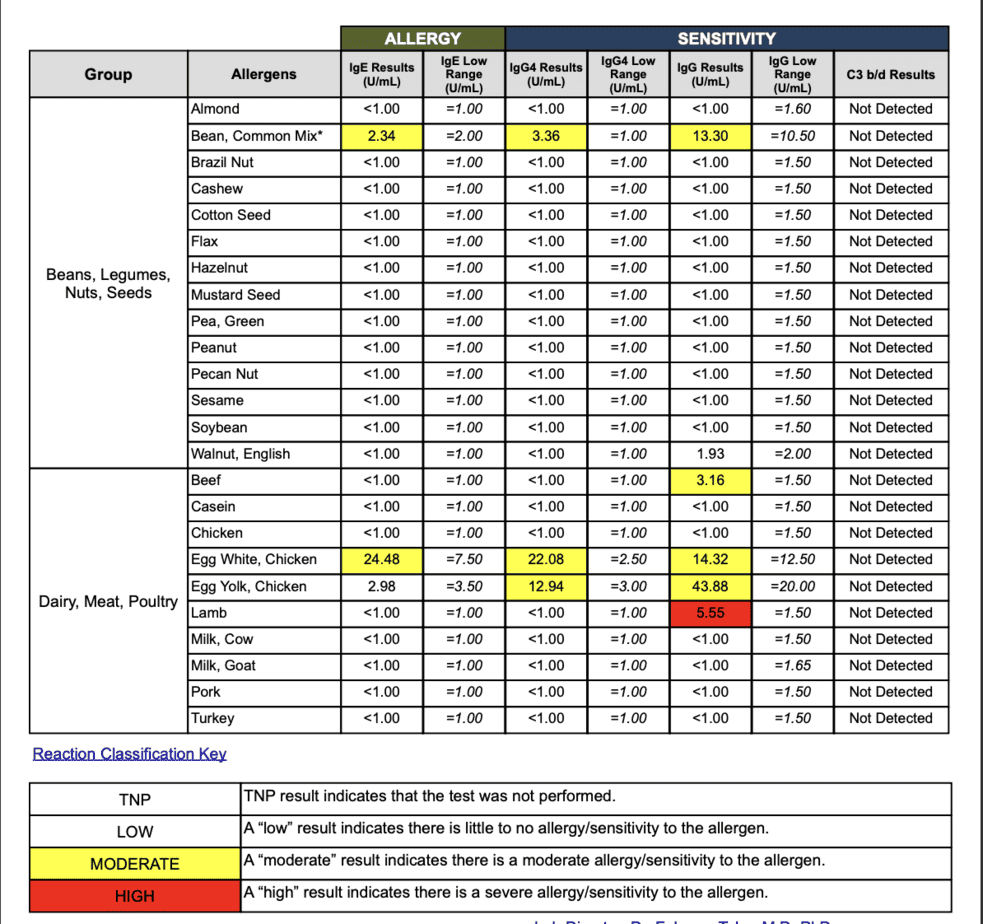
My own experience sealed it. After dealing with uranium toxicity, which can devastate gut integrity and trigger widespread inflammation, my gut was a mess. I couldn’t sort it out on my own, so I did a food sensitivity test. Some of what showed up genuinely surprised me. But I eliminated those foods for several months and felt so much better that I became a believer.
I’ve since successfully reintroduced all of the IgG-reactive foods. However, my IgE reactions to beans and chicken eggs remain.
I’ve changed my position because what I’ve seen, both in my own body and in my practice, has been too consistent to ignore. The research may be limited, partly for lack of funding and partly because testing companies use inconsistent methods. Nevertheless, the pattern in real people is hard to argue with. Removing reactive foods identified through food sensitivity testing repeatedly leads to improvement.
Why Testing Saves Time, Grief, and Guesswork
One of the most revealing things about food sensitivity testing is that the reactive foods are often not the usual suspects. Standard elimination diets target common offenders like gluten, dairy, soy, sugar, eggs, and corn. But the foods showing up on my clients’ panels are frequently things they eat regularly, sometimes daily, and would never have thought to question.
That brings its own challenge. Some clients have already severely restricted their diets by the time they come to me. They’re convinced they’ve found the problem when they’ve only found part of it. Ironically, the food they’ve been avoiding for years sometimes isn’t a trigger at all.
I want to be honest about the testing itself. IgG food sensitivity testing is controversial in conventional medicine. Not all food sensitivity panels are created equal, and results should always be interpreted in clinical context. That said, in my experience, when a client comes back with a significant number of reactions, the testing is telling a story. Remove the foods, heal the gut, and many or most of those foods can eventually be reintroduced.
Cherished foods are hard to let go of, even temporarily, but the goal is never permanent restriction. It’s giving your body the conditions it needs to heal.
Why You Shouldn’t Do This Alone
If you’re thinking about eliminating some of your suspected trigger foods, know that a proper elimination diet is more demanding than it sounds. It requires removing every offending food completely for about eight weeks, because even trace amounts can be enough to keep the immune response active. You also need to carefully log what you eat and any reactions so you can begin connecting foods with changes in how you feel.

Without guidance, you’ll either miss a reactive food or be so restricted it’s not sustainable long enough to get results.
With the right guidance, you can get help focusing on the foods you can eat and creating delicious, balanced meals with them. That way, you won’t feel totally deprived. You’ll also get a structured protocol for gut healing and a clear path through reintroduction.
Has Your Immune System Been Trying to Tell You Something?
If you’ve been chasing symptoms without answers, food sensitivities may be a significant piece of your puzzle. I help clients identify what’s driving their reactions, support gut healing, and eat what works for their body.
Ready to stop guessing? Schedule a free 15-minute chat HERE to explore food sensitivity testing and your next steps toward getting answers.

Want weekly Scripture, wellness tips, and anti-inflammatory recipes?
Subscribe to the newsletter below.
No spam. Unsubscribe anytime.