
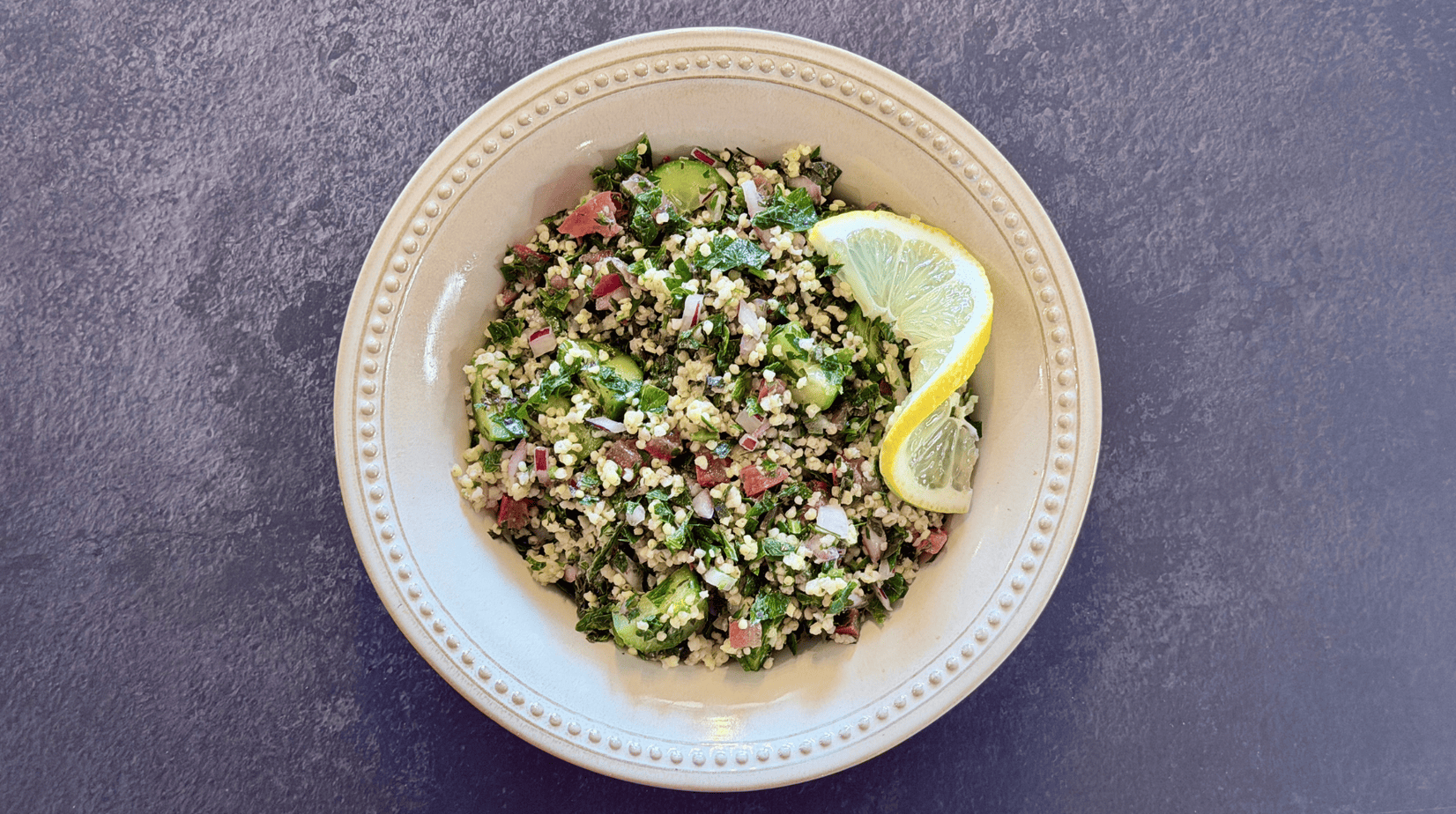
Gluten-free tabbouleh should taste like a summer salad, not a substitute: bright with lemon and packed with parsley, mint, cucumber, and tomato. In this version, millet replaces traditional bulgur wheat so anyone avoiding gluten doesn’t have to miss out on the deliciousness or gut-supporting ingredients.
How the Ingredients in Gluten-Free Tabbouleh Support Gut Health
Millet isn’t the only ingredient in this bowl doing something good for your gut. Here’s how each ingredient contributes:
Millet: As a naturally gluten-free whole grain, millet provides fiber that gut bacteria ferment into short-chain fatty acids that nourish the cells lining your colon. Chilling cooked starches can convert some of their starch into resistant starch, which escapes digestion in the small intestine and makes its way to the colon, where gut bacteria can use it for fuel.
Parsley: This isn’t just garnish here. There’s a lot of parsley in this recipe, and it provides fiber your gut bacteria can use. It’s also rich in apigenin, an antioxidant that interacts with gut bacteria and shows promise for supporting the intestinal barrier. Its chlorophyll may also help trap certain harmful compounds in the digestive tract before your body absorbs them.
Mint: This herb has been used to ease digestive discomfort for centuries, and compounds in mint can help relax the smooth muscles of the digestive tract.
Cucumber: Mostly composed of water, cucumber supports hydration, which is essential for healthy digestion and regular bowel function. It also contributes a small amount of fiber.
Tomato: Tomatoes provide pectin, a type of fiber your gut bacteria can ferment and use for fuel, and that fermentation produces short-chain fatty acids.
Lemon: Lemon does more than brighten the flavor. It contains eriocitrin, a flavonoid that gut bacteria break down into antioxidant and anti-inflammatory compounds that may help protect the intestinal lining.
Olive oil: The polyphenols in extra-virgin olive oil interact with gut bacteria, and research shows it can increase bacteria that produce the short-chain fatty acid butyrate.
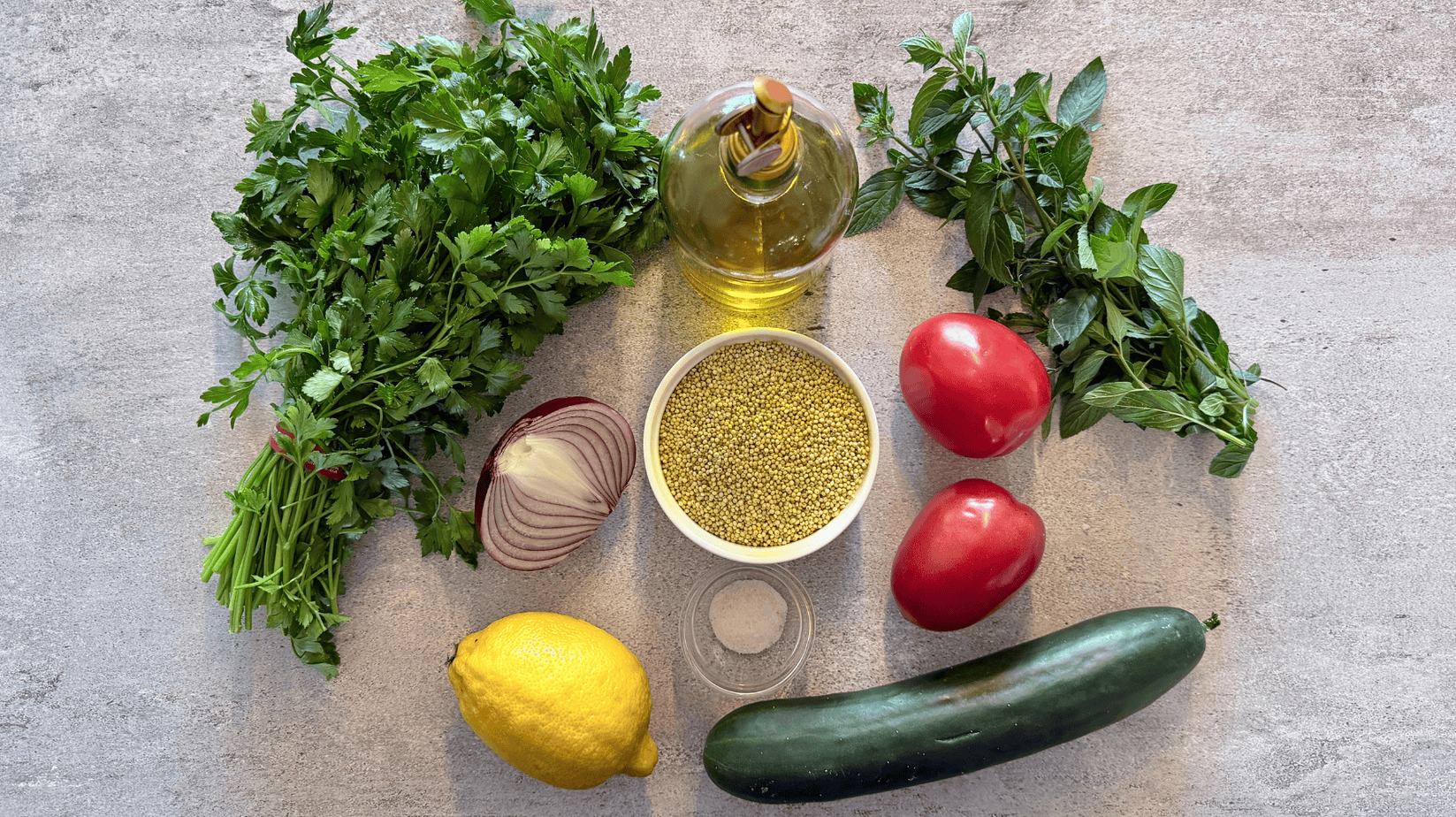
Together, these ingredients make gluten-free tabbouleh a dish that supports your gut with every bite, not just a gluten-free alternative to the original.
Gluten-Free Tabbouleh with Millet
Ingredients
- 3 tablespoons + 2 teaspoons extra-virgin olive oil, , divided
- 2/3 cup millet, , rinsed and drained
- 1 1/3 cups filtered water
- 1/2 teaspoon sea salt, , divided
- 1 medium lemon, , juiced
- 1/4 red onion, , chopped (or 3 scallions)
- 2 cups finely chopped parsley leaves, (loosely packed)
- 1/4 cup finely chopped mint leaves
- 1 medium cucumber, , peeled, seeded if watery, and cut into 1/2-inch cubes
- 2 Roma tomatoes, , seeded and finely chopped
Instructions
- Cook the millet: Warm 2 teaspoons of the oil in a saucepan over medium heat. Add the millet and toast, stirring, for 2–3 minutes, until it smells nutty. Add the water and 1/4 teaspoon salt. Bring to a boil, then reduce to a gentle simmer. Cover and cook for 15–20 minutes, until the liquid is absorbed and the grains are tender but still separate. Remove from the heat, let stand (covered) for 5–10 minutes, then uncover and fluff with a fork. Spread the millet out on a tray to let extra steam escape so the grains will stay loose. Cool it to room temperature before combining with the other ingredients or refrigerate it overnight to increase resistant starch.
- In a large bowl, combine the cooked millet and lemon juice. Add the remaining 1/4 teaspoon salt, scallions, parsley, mint, cucumber, tomatoes, and the remaining 3 tablespoons olive oil. Toss gently with two large spoons or spatulas until thoroughly mixed.
- Serve at room temperature or chilled.
Frequently Asked Questions
Can I use a different grain instead of millet?
Do I have to chill the millet overnight?
Can I use a different grain instead of millet?
Can I make this gluten-free tabbouleh ahead of time?
Is this recipe vegan?
What can I serve this with?

Want weekly Scripture, wellness tips, and anti-inflammatory recipes?
Subscribe to the newsletter below.
No spam. Unsubscribe anytime.
Sources
Durán González E, Ramírez Tejero JA, San Mauro Martín I, Terrén Lora A, Pérez Sánchez M, Gómez Morano R, Díaz López C, Martínez Lara A, Aguilar Díaz M, Cotán Marín D. Impact of a Mediterranean Diet Supplemented with Extra Virgin Olive Oil on Gut Microbiota in Fibromyalgia: A Randomized Controlled Trial. Life (Basel). 2026 May 26;16(6):894. doi: 10.3390/life16060894. PMID: 42355422; PMCID: PMC13301056. https://www.mdpi.com/2075-1729/16/6/894
Jubert C, Mata J, Bench G, Dashwood R, Pereira C, Tracewell W, Turteltaub K, Williams D, Bailey G. Effects of chlorophyll and chlorophyllin on low-dose aflatoxin B(1) pharmacokinetics in human volunteers. Cancer Prev Res (Phila). 2009 Dec;2(12):1015-22. doi: 10.1158/1940-6207.CAPR-09-0099. Epub 2009 Dec 1. PMID: 19952359; PMCID: PMC5314947. https://pmc.ncbi.nlm.nih.gov/articles/PMC5314947/
Kim J, Kim J, Jung Y, Kim G, Kim S, Shin H. Prebiotic potential of proso millet and quinoa: Effects on gut microbiota composition and functional metabolic pathways. J Microbiol. 2025 Jul;63(7):e2503002. doi: 10.71150/jm.2503002. Epub 2025 Jul 31. PMID: 40741631. https://jmicrobiol.or.kr/journal/view.php?doi=10.71150/jm.2503002
Mahendran G, Rahman LU. Ethnomedicinal, phytochemical and pharmacological updates on Peppermint (Mentha × piperita L.)-A review. Phytother Res. 2020 Sep;34(9):2088-2139. doi: 10.1002/ptr.6664. Epub 2020 Mar 16. PMID: 32173933. https://onlinelibrary.wiley.com/doi/10.1002/ptr.6664
Simpson HL, Campbell BJ. Review article: dietary fibre-microbiota interactions. Aliment Pharmacol Ther. 2015 Jul;42(2):158-79. doi: 10.1111/apt.13248. Epub 2015 May 24. PMID: 26011307; PMCID: PMC4949558. https://onlinelibrary.wiley.com/doi/10.1111/apt.13248
Yao L, Liu W, Bashir M, Nisar MF, Wan CC. Eriocitrin: A review of pharmacological effects. Biomed Pharmacother. 2022 Oct;154:113563. doi: 10.1016/j.biopha.2022.113563. Epub 2022 Aug 18. PMID: 35987162. https://www.sciencedirect.com/science/article/pii/S0753332222009520
Yüksel E, Voragen AGJ, Kort R. The pectin metabolizing capacity of the human gut microbiota. Crit Rev Food Sci Nutr. 2025;65(25):4823-4845. doi: 10.1080/10408398.2024.2400235. Epub 2024 Sep 12. PMID: 39264366. https://www.tandfonline.com/doi/10.1080/10408398.2024.2400235
Zhong S, Bird A, Kopec RE. The Metabolism and Potential Bioactivity of Chlorophyll and Metallo-chlorophyll Derivatives in the Gastrointestinal Tract. Mol Nutr Food Res. 2021 Apr;65(7):e2000761. doi: 10.1002/mnfr.202000761. Epub 2021 Mar 1. PMID: 33548074. https://onlinelibrary.wiley.com/doi/10.1002/mnfr.202000761