

My gynecologist prescribed an estrogen cream at my last visit, and my husband picked it up before I had a chance to read the label. One look at the ingredient list and I knew I wouldn’t be using it because I’ve learned the hard way that inactive ingredients in medications matter just as much as the active ingredient.
Just as it’s important to read labels on food, we need to know everything that’s in the medications we’re prescribed. Medication applied to your skin is still absorbed into your body.
The Problem with Hidden Inactive Ingredients in Medications
Every medication contains two categories of ingredients: active ingredients, which are the drug itself, and inactive ingredients, also called excipients. Inactive ingredients in medications include fillers, binders, preservatives, coatings, and dyes. These inactive ingredients make up the bulk of most pills, creams, and liquid formulations. They affect shelf life, texture, color, taste, and manufacturing efficiency.
What they don’t necessarily do is promote health.
Unlike food labels, medication package inserts rarely identify the specific source of an ingredient. Starch could mean corn starch. Modified food starch almost certainly does. Natural flavors tells you nothing. And because manufacturers can change ingredient suppliers at any time, a medication you’ve tolerated for years can suddenly cause a reaction with the next batch. They won’t warn you, and your pharmacist may not know.
This isn’t because your practitioner doesn’t care. It’s because pharmaceutical excipients simply aren’t part of medical training. Your prescriber knows the drug. They were never taught to question what it’s packaged in. In the most charitable sense, nobody trained them to consider it.
Why It’s So Hard to Find Inactive Ingredients in Medications
The published ingredient lists are a starting point, but they can’t be fully trusted because of the supplier-change problem. DailyMed, a database run by the National Library of Medicine, pulls ingredient information directly from FDA-approved package inserts and is worth bookmarking for medications you’re currently taking. But for anything beyond that, you need a pharmacist willing to call the manufacturer directly, and finding one with the necessary time and commitment takes some searching.
For those of us who are highly sensitive or have autoimmunity or multiple allergies, this isn’t optional due diligence. It’s necessary. Every time you fill a prescription without checking, you are to some degree gambling with ingredients you never agreed to take.
Common Inactive Ingredients in Medications to Watch For
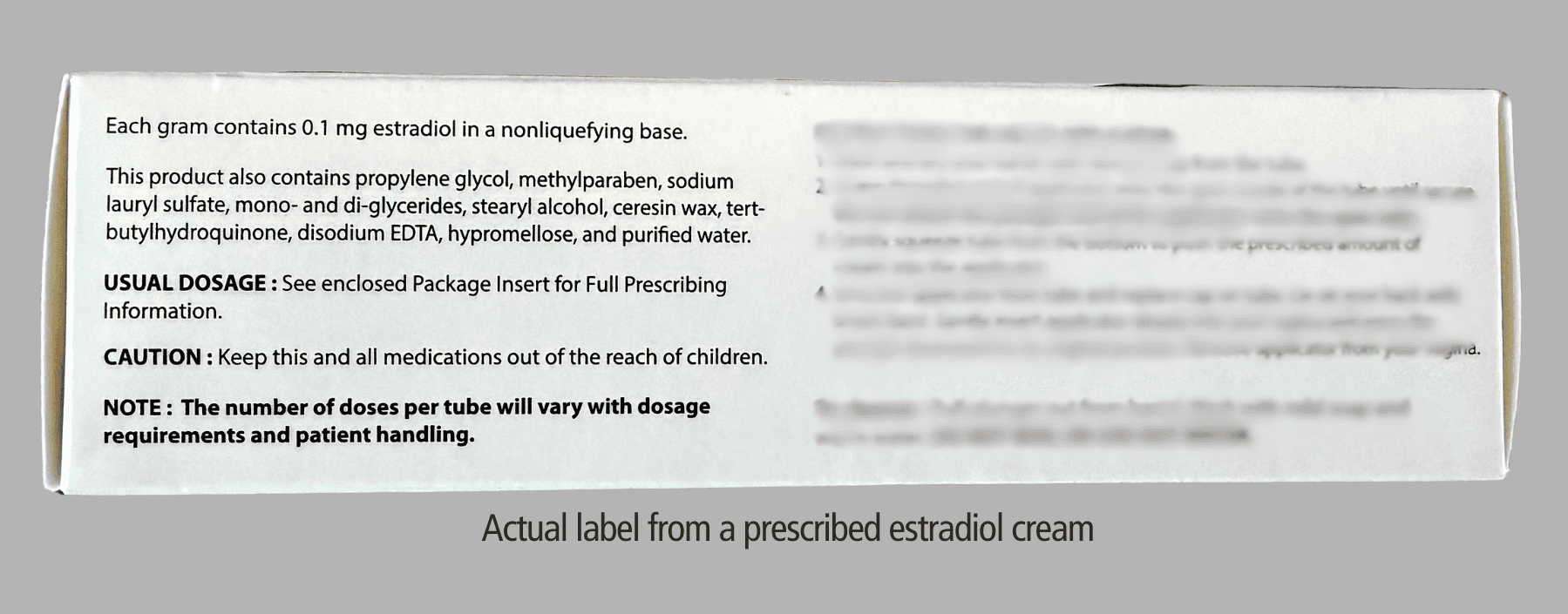
The following are ingredients that were in the cream I was prescribed. They are standard excipients found across thousands of medications, including ones that may be sitting in your cabinet right now.
Sodium Lauryl Sulfate (SLS) is a detergent and emulsifier that strips the mucosal lining, the skin’s protective barrier. It’s commonly used in toothpaste, and studies show it causes a 64% increase in canker sores by damaging the oral mucosa. If it does that to your mouth, imagine what it does to other sensitive tissue.
Propylene Glycol is a penetration enhancer and solvent that increases absorption of other ingredients through the skin. It is a known irritant and allergen, and its presence in a topical formulation means other ingredients in that product are driven deeper into your tissue along with it.
Parabens are synthetic preservatives that prevent bacterial growth and extend shelf life. They have weak estrogenic activity and are absorbed topically. Allergic reactions occur in some individuals, and for anyone with hormone-sensitive conditions, adding even weakly estrogenic compounds to the body’s total burden is worth considering.
Mono- and Diglycerides are emulsifiers derived from processed fats that can introduce trans fat isomers during manufacturing. Trans fats promote inflammation and are associated with cardiovascular disease, insulin resistance, diabetes, and obesity. The FDA considers them generally recognized as safe for food use, but that designation has not kept pace with the research. Their presence in medications, including topical ones, means they are absorbed directly into tissue.
Disodium EDTA is a chelating agent that binds metal ions to prevent product degradation. It also enhances the absorption of other chemicals through the skin, can irritate compromised tissue, and because it binds metals required for normal cell division, some research shows weak mutagenic activity. It keeps products looking and smelling stable on the shelf. That is its purpose.
Tert-Butylhydroquinone (TBHQ) is a synthetic preservative added to prevent oxidation. However, research shows it can act as a pro-oxidant depending on dose and has been shown to damage and kill cells. Regulators call it safe at the concentrations used in individual products, but that doesn’t account for cumulative exposure across multiple products or the reality of applying it to already-compromised tissue.
When the Medicine Contradicts the Treatment
The ingredients in the cream my gynecologist prescribed are the same as every other conventional cream. Doctors prescribe it to treat sensitive tissue, yet the ingredients are known to irritate, inflame, and compromise sensitive tissue. That is not a small oversight. It is the result of an industry that prioritizes shelf stability, cost efficiency, and ease of mass production over ingredient quality—and a regulatory environment that has historically allowed it.
The irony repeats across drug categories: anti-inflammatory medications formulated with inflammatory excipients. Immune-modulating drugs containing immune-reactive dyes. Gut-healing protocols delivered in capsules with corn starch that triggers the patient’s sensitivities.
Then there are more recognizable ingredients, especially to those managing food sensitivities: lactose in medications prescribed to lactose-intolerant patients, gluten-containing starches in tablets and capsule coatings, and high-fructose corn syrup in liquid formulations. Manufacturers use talc and titanium dioxide—both controversial for their carcinogenic potential—for powder flow and color consistency. Artificial dyes linked to behavioral issues and allergic reactions appear in capsules and liquid medications.
There is also the matter of which drug is being prescribed in the first place. The conventional cream uses estradiol, the most potent form of estrogen and the form associated with increased cancer risk in hormone replacement therapy. The compounded product it was to replace contains estriol, the gentlest form of estrogen, with more localized effects and significantly less systemic absorption. Many functional practitioners prefer estriol for vaginal use; most conventional physicians prescribe estradiol by default. Most patients don’t know there’s another option.
A Note on Compounding Pharmacies
Compounding pharmacies exist specifically to solve this problem. A compounding pharmacist can formulate your medication using clean bases like coconut oil, cocoa butter, or hyaluronic acid—without SLS, parabens, trans fats, PEG, or synthetic preservatives. Your prescriber can specify exactly what to include and what to exclude.
Compounding isn’t just for people who are allergic to ingredients in commercial products. Choosing to avoid potentially harmful ingredients when cleaner options exist is a legitimate medical choice, and respectful practitioners should honor it.
Unfortunately, compounding pharmacies face disproportionate regulatory pressure. A single adverse event involving a compounded medication makes national news. Adverse events involving mass-manufactured pharmaceuticals happen daily and rarely receive the same scrutiny or coverage. The disparity doesn’t reflect a difference in safety. It reflects the financial stakes involved in protecting a very large industry.
Polyethylene Glycol: A Personal Case Study

Now I have my famotidine compounded without PEG. But I only know to do that because I read labels and knew about compounded products.
This isn’t an edge case. This is the norm. You’d think we could trust trained healthcare practitioners to think to check what’s in the medications they’re dispensing, but we can’t. The burden of knowing what’s in our medications falls on us.
What You Can Do
Start by reading the labels and inserts for the medications you’re prescribed, paying close attention to the inactive ingredients in medications—not just the active drug. If you don’t have the insert, you can look up the ingredients on DailyMed. Treat it as a starting point, not a final answer—hidden ingredients like gluten may not be listed, and suppliers can change with any batch.
Find a pharmacist who will advocate for you. This means calling manufacturers when ingredient questions arise, flagging potential interactions between excipients and known sensitivities, and treating the whole formulation—not just the active ingredient—as relevant to your care. They exist and are worth finding.
When your prescriber recommends a medication, ask what the inactive ingredients are, whether a compounded version is available, and whether alternatives exist for the active ingredient itself. Ask why one is recommended over another. A good practitioner will engage with those questions. One who dismisses them is telling you something important about how they view your role in your own care.
You are not obligated to accept a prescription as written. You are not obligated to fill it without reading the label. And you are not obligated to take something that conflicts with your health goals simply because someone with credentials handed it to you.

Your body is a temple. Treat every ingredient accordingly.
If you’d like help researching what’s in your medications or preparing for an informed conversation with your practitioner, schedule a complimentary 15-minute chat with me here.

Want weekly Scripture, wellness tips, and anti-inflammatory recipes?
Subscribe to the newsletter below.
No spam. Unsubscribe anytime.